


Have you ever encountered a cause of arrest that falls outside of the common “Hs and Ts?” Share it along with this article to social media. Through shared experiences and continuous education, we can save more lives. Also, remember to enroll in your advanced care course to treat cardiac arrest too!
THIS PICTURE LOOKS OLD AND GRAINY BECAUSE IT IS. That is me in nursing school, almost ten years ago (I’m screaming internally). Sit down because I am about to get serious with you and let you in on a scary reality that most nurses know but don’t discuss.
The face of nursing is changing. It has been. It is not a good thing.
 A family member had been admitted to the hospital. I accompanied her to get her settled on the floor, in doing so, met her nurse, who was being trained by another nurse (we will call her Mary). Mary and I got chatting and she explained that she trained for a period in my unit during her nursing education. Upon discussing this, she mentioned shadowing a nurse that had been on my unit for a short period of time and had left. From my calculations, she shadowed a nurse who had been working on my unit for 1-2 years (who was already gone), and that had made her a staff nurse for approximately one year or so. Subtracting a generous 12-week orientation, Mary (who has been practicing independently for a liberal approximation of 8-10 months) was now in the process of training a brand new nurse.
Do you see a problem here?
This revolving door of nursing is creating problems for patients, cost increases (for everyone), and issues for those of us who do decide to stay at the bedside. Nurses are leaving in droves, and novice nurses are teaching more novice nurses. According to the RN Work Project, a study performed over ten years to track career changes among new nurses, 17.5% of new nurses left their position within a YEAR of starting a new job, 33% within two years, and 60% within eight years.
What does that mean to you? That means there is a high probability of you getting a pretty “green” nurse when you walk into a hospital. You might notice that half the staff look like they just graduated from college, which sometimes is true. (Scary, right?) However, just because you have an older RN doesn’t mean that they have the experience, much of the workforce is second-degree nurses, and you can’t trust the age to tell you about the level of competence. All RN nurses are responsible for participating in an appropriate continuing education activities. Basic Life Support (BLS) certification is required for all registered nurses.
This matters. Statistically speaking, experienced nurses help patient outcomes. This means that there are fewer hospital-acquired pressure ulcers (bed sores), infections, etc. with a staff of qualified nurses. A study published on Nursing World concluded that increasing experience (to an average of 5 years) and clinical hours (6 hours a day to 7 hours a day) could lower incidences of hospital-acquired pressure ulcers by 11.4% and falls by 7.7%.
What does that mean? It means $$$$$$. Experienced nurses would save hospitals money because as it stands now, hospitals aren’t being reimbursed by Medicare and Medicaid Services (CMS) what they consider “hospital-acquired conditions” like pressure ulcers over a Stage II. To you non-nursing people, this means when you get a bedsore that opens up and becomes difficult to heal, its considered preventable, so CMS isn’t paying for it.
Now in ways, these things are preventable, just like urinary tract infections from urinary catheters, however, the way to prevent those things is to have STAFF. Having a competent, experienced nursing staff along with an adequate support staff, such as nursing assistants, can make the difference. Pressure ulcers are preventable if you turn patients, if there aren’t enough staff on hand to do the turning, they become less “preventable.”
This is an issue not because nurses are aging out, not because of “nursing shortages” but because of the hospital environment. Nurses are overworked, understaffed. Units with a high census and acuity take a toll on even the most experienced nurses. Patients are heavier both literally (in weight) and with more comorbidities. We have modalities to keep the most critically ill patients alive for inordinate amounts of time, and these are only small parts of the cause of the bigger problem.
Money is the driver for much of the issue, and we are doing more, quicker, with less support than ever before. We are required to work long shifts without breaks, hold our bladders, skip lunches, and keep going. We are required to work weekends, holidays, nights, long stretches of 12-hour shifts that become 14-hour shifts. We get berated, verbally, and physically assaulted, accused of withholding pain medication, letting food get cold. We are literally breaking our backs- some estimate the average nurse lifts 1.8 tons per shift. Why would you stay at the bedside?
So people leave. They go to a clinic, become visiting nurses, go back to school, pull back their hours, or stop working. Who would blame them? Advanced education means a bigger paycheck and better hours. No double knee replacements at 60 or slipped disks at 35. Why would you stay?
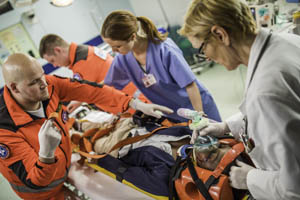 New nurses look cost-effective initially, losing a nurse with 12 years of seniority to gain someone who will be paid at an entry-level rate sounds like cost savings, but unfortunately, this isn’t the reality. Once they finish orientation, they stay a short time and then move on to school or burnout and leave the bedside altogether. This is not cheap. According to The Costs and Benefits of Nurse Turnover: A Business Case for Nurse Retention, “Recent studies of the costs of nurse turnover have reported results ranging from about $22,000 to over $64,000 (U.S.) per nurse turnover”.
More importantly, more than cost, there is something to be lost when good, experienced nurses leave the bedside. Institutional knowledge, experience gained from years within an organization are lost, and with it, the patient experience suffers, or worse. There was a study performed at 38 hospitals and on 20,407 patients between 2009 and 2010 called The Effect of Critical Care Nursing and Organizational Characteristics on Pediatric Cardiac Surgery Mortality in the United States. The study concluded that “the odds of death significantly increased when the percentage of RNs with two or fewer years of clinical experience was 20 percent or more.” Due to the results of the study, it was recommended that “pediatric ICUs should have no more than 20 percent of their staff with less than two years’ experience.”
Layman’s terms, patient mortality, and outcomes have a lot to do with how long your nurse has been doing his or her job.
Nursing is a lot more than bedpans and med passes, there is a lot more that goes into the minute-to-minute decisions that aren’t taught in a classroom or on orientation. In teaching hospitals, this is even more important. Residents coming onto the floor are fresh out of med school and honestly depend on experienced nurses to be their double-check at times, nursing being the last line of protection to the patients. If the nurses are new and the prescribers are new, it can spell disaster for people in the beds. You’ve all seen the Scrubs meme where the nurse speaks to the more experienced physician saying, “Doug wanted me to give this patient five hundred thousand milligrams of morphine. I thought I’d check with you before I kill a man.” This is funny because it’s true. Mistakes happen, you want the person giving you or your husband or wife or child to recognize the error before giving the medication.
There are so many of us devoted to this career who want to see it succeed. I want to work alongside a staff of experienced, dedicated staff whose priority is the patient above all. I have had the pleasure of working with some phenomenally experienced nurses throughout my career and have seen newbies blossom into some of the most amazing nurses I know. I want people to stay and for patients to get the care they expect to in the hospital (minus the expectation of dinners for their extended families and five extra pillows- I don’t work at the Hilton).
Retention is key, I want to stay at the bedside, and I know many that do. The face of the bedside doesn’t need to keep changing. Management and hospital administrations need to play a more active role. Hospital administrators need to address this hemorrhaging of experienced staff, through better ratios, staffing, schedules for better work-life balance, and retention projects. Spend the money allocated for hiring bonuses on your experienced staff, and you won’t need to keep hiring. It will be more cost-effective, and more importantly, patient outcomes depend on it.
My name is Jennifer. I am a twenty-something (I hate that term) wife, mother and RN from Connecticut. I have never lived anywhere else, traveled or done anything to make myself cultured or well-read. I’m not all that interesting. I have no freaking clue what I am doing or talking about. I’m doing things- aimlessly and without any sense of if I am doing them right/well. FYI: you probably are too. This blog is a collection of essays of my thoughts, opinions, trials and experiences figuring out how to be a fully functional adult. Trying to find my purpose in the chaos. Read at your own risk and enjoy!












Wow, you have capsulized perfectly a lot of what and why there is loss of bedside nurses – without sounding angry and crazy. I’ve been a nurse since ’84 and find myself more and more frustrated with the course health care and bedside nursing practice is taking. CEOs, administrators, managers, and the public need to read your article. I am retiring in the next 5 years and coming to realize I haven’t been able to help “heal” what’s wrong with “the system”. You are doing a great service promoting the cause and respect for “in the trenches” nursing. Thanks.